
Why your local business needs a Google Business Profile
What a Google Business Profile is, how the map pack and “near me” results work, and why it matters for every local business.
Read more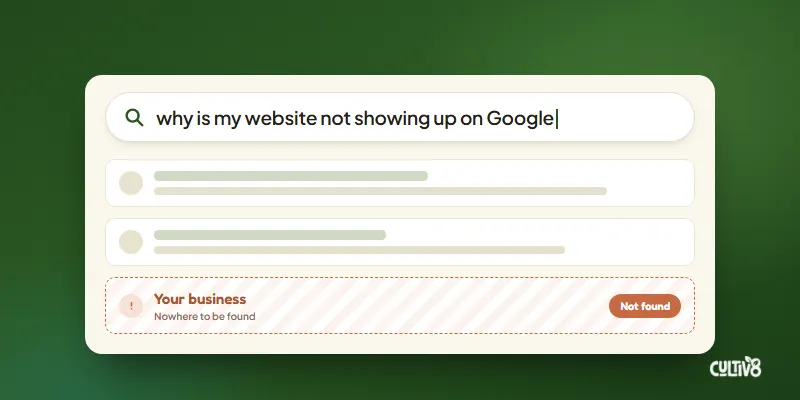
You type your business name into Google, scroll, scroll again, and there is no sign of you. It is a sinking feeling, especially when you paid good money for the website. The good news is that the cause is almost always one of a handful of fixable problems. Google has not found the site yet, something on the site is telling Google to stay away, or Google has found you but other pages are beating you to the top.
Below are the nine reasons we see most often when Scenic Rim business owners ask us why their website is not showing up on Google, how to check each one yourself, and what to do about it.
In Australia, Google is not just the biggest search engine, it is nearly the only one. If your business is missing from Google, it is missing from almost every search your customers make.
Source: StatCounter Global Stats, all platforms, September 2026.
Google itself is upfront that it does not promise to list anyone. In its own words, “Google doesn’t guarantee that it will crawl, index, or serve your page, even if your page follows the Google Search Essentials” (Google Search Central). So the job is to remove every reason Google has to leave you out, then give it reasons to rank you.
Google finds websites by following links and reading sitemaps. A brand new site with no links pointing to it can sit unnoticed for a while. Google says that “it can take a few weeks for Google to notice a new site, or any changes in your existing site” (Google Search Central).
How to check: search Google for site:yourbusiness.com.au (with your own domain). If nothing comes back, Google has not indexed the site yet.
How to fix it: set up a free Google Search Console account, verify your domain, submit your sitemap and use the URL Inspection tool to request indexing of your home page. Then be patient for a few weeks before assuming something is broken.
This one catches out more businesses than you would think. While a website is being built, developers often switch on a setting that hides it from search engines, and sometimes nobody switches it off at launch. In WordPress it is a single tick box called “Discourage search engines from indexing this site”. Elsewhere it is a noindex tag in the page code, a password on the whole site, or a robots.txt file blocking crawlers.
A noindex tag is especially brutal: Google will drop that page completely, however many other sites link to it. Robots.txt causes the opposite confusion, because Google notes that it “is not a mechanism for keeping a web page out of Google” (Google Search Central). Blocked pages can still turn up as a bare link with no description, which looks broken to customers.
How to fix it: in Search Console, open the Pages report. It lists every page Google has chosen not to index and the reason, such as “Excluded by noindex tag” or “Blocked by robots.txt”. Ask whoever built your site to remove the block, then request indexing again.
Plenty of owners find their business when they type its exact name, but vanish when they search for what they actually do, like “electrician Beaudesert” or “cafe Tamborine Mountain”. Google matches searches to the words and topics on your pages. If your home page says “Welcome to Smith & Co, quality you can trust” and never mentions electrical work or a town, Google has nothing to connect you to that search.
How to fix it: give each main service its own page, and say plainly what you do and where you do it in the page title, the main heading and the first paragraph. Write the way your customers talk, not the way your industry does.
When someone searches for a local service, the first thing they usually see is a map with three businesses under it, known as the map pack. Those listings come from Google Business Profiles, not websites. No profile means no spot on the map, however good your website is.
Google ranks local listings on three things. “Relevance is how well a Business Profile matches what someone is searching for.” “Distance refers to how far each business is from the customer who’s searching.” And “prominence means how well-known a business is” (Google Business Profile Help). The same page adds that “there’s no way to request or pay for a better local ranking on Google”.
How to fix it: claim and verify your profile, choose the most accurate primary category, fill in every section, add real photos and link it to your website. Our guide to why your local business needs a Google Business Profile walks through it.
If the site: search shows your pages, you are indexed. You may simply be on page two or three, which in practice is the same as not being there. Other businesses may have older websites, more pages, more reviews or more local links, and Google rewards that history.
Even page one is no longer the finish line. Google now puts AI-written answers above many results. Pew Research Center found that “users who encountered an AI summary clicked on a traditional search result link in 8% of all visits”, compared with 15% when no summary appeared (Pew Research Center, July 2025, US data).
How to fix it: this is where steady, ongoing search engine optimisation earns its keep: better pages, local content, reviews and links, built up month after month so you climb above the businesses currently ahead of you.
Google uses the mobile version of your website to decide where you rank (Google Search Central), and in September 2026 phones made up 48.57% of web use in Australia (StatCounter). A site that is slow, jumps around as it loads or is hard to tap through on a phone is working against you.
How to fix it: test your home page in Google’s free PageSpeed Insights tool and look at the mobile score. Heavy themes and stacks of plugins are the usual culprits. This is a big part of why we build fast, lightweight headless websites and pair them with ongoing SEO.
Google looks for evidence that real people know and use your business. That means reviews, mentions of your business on other websites, and the same name, address and contact details everywhere you are listed. Customers look for the same things. In BrightLocal’s 2026 survey of US consumers, “97% of consumers read reviews for local businesses” (BrightLocal).
How to fix it: ask every happy customer for a Google review, list your business consistently in reputable directories, and look for genuine local links, like your chamber of commerce, suppliers, sponsors and community groups.
Sometimes Google can reach your site but gets mixed messages. Common examples are a move to a new domain without redirects, the same pages living at both www and non-www addresses, pages that point Google at the wrong “main” version of themselves, a sitemap full of dead links, or content that only appears after heavy JavaScript runs.
How to fix it: the Pages report in Search Console is your friend again. It groups the problems so you can see whether one fault is affecting dozens of pages. Technical fixes like these are usually quick for a developer, once you know what they are.
Least common, but worth ruling out. Google’s spam policies cover tactics that “can lead to lower ranking or being completely omitted from Google Search results” (Google Search Essentials). Bought links, copied content and keyword stuffing can all land a site there. So can a hacked website that has been quietly loaded with spam pages without the owner knowing.
How to fix it: check the Manual actions and Security issues reports in Search Console. If either shows a problem, clean up the cause first, then ask Google to review the site.
Customers are also starting to ask AI tools for recommendations. BrightLocal found that use of ChatGPT and other generative AI tools for local recommendations rose “from 6% last year to 45%” (US consumers, 2026). Those tools lean heavily on the same signals as Google, so fixing the nine problems above helps you there too.
If you have worked through the list and still cannot find yourself, or you would rather hand it to someone who does this every day, our SEO service starts with a plain-English look at exactly why your website is not showing up on Google and what it will take to fix it. We are based in Beaudesert and work with businesses across the Scenic Rim and nearby Logan. Get in touch for a free, no-pressure quote.
The things Scenic Rim business owners ask us most about showing up on Google.
Still stuck? Have a chat with a local. We are happy to take a look, and there is never any pressure.
Get in touchMore local know-how to help you get online and get found.
What a Google Business Profile is, how the map pack and “near me” results work, and why it matters for every local business.
Read more
What a headless website actually is, how it works, and why it means faster pages, better security and stronger SEO and AI search results.
Read more
Tell us a little about your business and we will get back to you within one business day. No pressure, no jargon, just a friendly local crew ready to help you grow.
cultiv8digitalagency (at) gmail.com